Intermittent fasting is a powerful strategy to improve our health.
So, what is Intermittent fasting? It is a scheduled eating; fast (no food) for 16 hours, and eat during 8 hours in a 24 hour day. This 16 - 8 is the standard.
After 12 hours without food, the stored glucose from the food we consumed previously will be depleted and for the next 4 hours our body will try to burn stored fat as fuel.
Drinks,- water, cofee and tea without milk or sugar is allowed during the fasting period. If we do this regularly our body will adapt and start burning fat as fuel. By limiting sugar and high carb food consumption, this will be achieved sooner. And if you exercise one to two hours before your first meal, the fat burning will be accelerated even more.
Intermittent fasting gives our digestive system a rest and time to recover. Also very important - it trains our body to use fat as the primary fuel. Like a hybrid car, our body has dual fuel system, glucose and fat. Fat is more efficient and clean burning fuel compared to glucose, which means we need less of it to produce the same energy and produces less after burn garbage (free radicals). This is great for our metabolic health, the health of our cell mitochondria.
We are accustomed to burning glucose as our primary fuel due to our eating habit; consuming a lot of sugar, and high-carb diet.
Intermittent fasting coupled with less sugar and less simple carbohydrate consumption enable our body to switch to burn fat as our primary fuel. This has multiple benefits for our health. It reduces the risk of cancer, type 2 diabetes, Alzheimer, cardiovascular disease, obesity and helps control body weight.
When your body can switch from burning glucose to burning fat as primary fuel easily, you will not feel the hunger or unsatisfied feeling or sweet craving as much anymore, because your cells, especially the brain cells, can now use ketones (from fat) as fuel and not rely only on glucose.
After almost 2 years of Intermittent Fasting most days (not every day), I have dropped my body fat form 20% to 13%; this was achieved with less time spend on exercise. My craving for sweets and carb diminished.
Here is one of several websites that provides body fat percentage calculator - bodyfat
Warning: This strategy, Intermittent Fasting, is not for everyone; especially if your health is being challenged already at this time. If you decide to try it out, ease into it. I started with, - stop eating around 8 PM, 3 hours before bedtime. Tea (without sugar or milk) is o.k. but nothing with carb. Sometimes I have chamomile tea. Next, the following step is - postpone breakfast time by 1 hour. A week later by 2 hours, etc. Soon my eating schedule is - first meal around 12 noon, last meal around 8 PM. Currently I am more relax, my fasting period is sometimes 14 or 15 hours.
If your current health condition permits, I highly recommend that you try this Intermittent fasting strategy to improve your health. It has helped me, and it costs nothing.
Just do not over do it, once you know that your body can switch to burning fat, you can ease up and take a break from fasting now and then.
Any comment or question, please post below.
Thanks for reading my post, hope you find it helpful.
Tuesday, 7 March 2017

Wednesday, 15 February 2017
My diet
You are what you eat......
Make food be your medicine.........
I do not follow any diet plan, but I do have principles that I follow as far as eating is concerned.
Avoid Sugar, avoid transfat.........
Sugar and transfat are toxins to our body. Many articles and books were written about this; and I am convinced that we have to avoid sugar and transfat.
We have to learn and read labels to know which food to avoid, it is not always obvious.
Occasionally I do enjoy ice cream, cake, beer and wine; always with some food already in the stomach and in small amount. To mitigate the bad consequence, I took a couple capsules of fibre, like 'Meta mucil' and if possible indulge on those "treats" after a vigorous exercise so that the glucose is absorbed into the muscle tissues.
Eat a balance meal in moderation..........
Some carbohydrate, some protein and some fat; all three macro nutrients for a balance meal. I do not favour one over the other. Some diet plans are low carb, high fat while others high carb, low fat.
Too much of any good thing becomes toxic. I think balance meal and eat in moderation is the wise thing to do.
Yes, fat is also important. But consume only good fat, like olive oil, coconut oil, avocado oil and ghee. Fried foods cooked with vegetable oil have lots of transfat. Frequently, I put a tbsp of coconut oil in my coffee and tea.
The human teeth is designed to process a variety of foods, from seeds, nuts, grains, vegetables, fruits, fish to meat. So I eat a variety of foods.
Eat more complex carb and less simple carb........
That means more fibrous vegetables and some fruits; and less pasta, bread, potatoes and rice.
Chilled potatoes and rice after cooking, like potato salad and sushi, they became much healthier because the starch became 'resistant starch' and pre-biotic, that means it is good for our gut flora.
Eat more pro-biotic and pre-biotic food.............
This is important to support our microbiome, gut flora health. Kefir, kombucha and fermented vegetables like sauerkraut, kim chi are pro-biotic. See my earlier blogs about how I make Kefir, Kombucha and Sauerkraut. Fibrous vegetables and resistant starch are pre-biotic.
Pro-biotic food provides a variety of good bacteria to populate our gut, and pre-biotic food provides food for the good bacterias to flourish in our gut. Pre-biotic food is not digested in the small intestine.
Microbiome is the collection of trillions of microbe that live in the human body. The largest and most diverse bacteria strains is found in our gut, the digestive track, especially in the colon.
Both good and bad bacterias are present in our gut. A healthy gut flora is very important to our health because 80 % of our immune system is in the gut.
Do not overeat.........
Overeating puts a lot of stress to our digestive system including the pancreas and liver organs. In the long run this may cause damage to our body. Eat only until you are 80% full, is a good advise; that is the advise from the Okinawan centenarians.
Give the digestive system a rest..........
The digestive system needs a reprieve from constant stress, to recover and stay healthy. It took 12 hours for the body to totally process all the food from our last meal; that is why we have to fast for 12 hours for a blood lipid and glucose test. So a 12 hours or more rest (fast) for the digestive system is reasonable. I regularly fast for 13 to 16 hours; more on this subject next time in another blog.
Say grace for each meal............
By saying thanks and asking for blessing, we put our mind and digestive organs in the proper state to receive and process the meal.
There you have it, that is my 'diet' which I do not follow 100% of the time -:).
Update:
After my MRI prostate scan early June 2017, I went on a strict diet.
I no longer consume any kind of refined sugar and avoid simple carbohydrate as much as possible, which means that I avoid alcohol, fruit juice, pops, cake, cookies, ice cream, process snacks, white rice, noodles, pasta, potato, bread, sweet fruits etc.
Science has proven that cancer cells can only use and process glucose to produce their energy by fermentation without oxygen. Healthy cells can use glucose as well as ketones (from fat) as their source of energy.
By embarking on this strict diet, I limit the availability of glucose for the the cancer cells to use thus curtailing their growth.
Fasting and exercise deplete the glucose supply further. Exercise also oxygenate the cells more, all these actions, diet, fasting and exercise, help create a hostile environment for the cancer cells.
Thanks for reading my blog, hope you find it useful.
Please leave your comments and questions below. Thanks.
Make food be your medicine.........
I do not follow any diet plan, but I do have principles that I follow as far as eating is concerned.
Avoid Sugar, avoid transfat.........
Sugar and transfat are toxins to our body. Many articles and books were written about this; and I am convinced that we have to avoid sugar and transfat.
We have to learn and read labels to know which food to avoid, it is not always obvious.
Occasionally I do enjoy ice cream, cake, beer and wine; always with some food already in the stomach and in small amount. To mitigate the bad consequence, I took a couple capsules of fibre, like 'Meta mucil' and if possible indulge on those "treats" after a vigorous exercise so that the glucose is absorbed into the muscle tissues.
Eat a balance meal in moderation..........
Some carbohydrate, some protein and some fat; all three macro nutrients for a balance meal. I do not favour one over the other. Some diet plans are low carb, high fat while others high carb, low fat.
Too much of any good thing becomes toxic. I think balance meal and eat in moderation is the wise thing to do.
Yes, fat is also important. But consume only good fat, like olive oil, coconut oil, avocado oil and ghee. Fried foods cooked with vegetable oil have lots of transfat. Frequently, I put a tbsp of coconut oil in my coffee and tea.
The human teeth is designed to process a variety of foods, from seeds, nuts, grains, vegetables, fruits, fish to meat. So I eat a variety of foods.
Eat more complex carb and less simple carb........
That means more fibrous vegetables and some fruits; and less pasta, bread, potatoes and rice.
Chilled potatoes and rice after cooking, like potato salad and sushi, they became much healthier because the starch became 'resistant starch' and pre-biotic, that means it is good for our gut flora.
Eat more pro-biotic and pre-biotic food.............
This is important to support our microbiome, gut flora health. Kefir, kombucha and fermented vegetables like sauerkraut, kim chi are pro-biotic. See my earlier blogs about how I make Kefir, Kombucha and Sauerkraut. Fibrous vegetables and resistant starch are pre-biotic.
Pro-biotic food provides a variety of good bacteria to populate our gut, and pre-biotic food provides food for the good bacterias to flourish in our gut. Pre-biotic food is not digested in the small intestine.
Microbiome is the collection of trillions of microbe that live in the human body. The largest and most diverse bacteria strains is found in our gut, the digestive track, especially in the colon.
Both good and bad bacterias are present in our gut. A healthy gut flora is very important to our health because 80 % of our immune system is in the gut.
Do not overeat.........
Overeating puts a lot of stress to our digestive system including the pancreas and liver organs. In the long run this may cause damage to our body. Eat only until you are 80% full, is a good advise; that is the advise from the Okinawan centenarians.
Give the digestive system a rest..........
The digestive system needs a reprieve from constant stress, to recover and stay healthy. It took 12 hours for the body to totally process all the food from our last meal; that is why we have to fast for 12 hours for a blood lipid and glucose test. So a 12 hours or more rest (fast) for the digestive system is reasonable. I regularly fast for 13 to 16 hours; more on this subject next time in another blog.
Say grace for each meal............
By saying thanks and asking for blessing, we put our mind and digestive organs in the proper state to receive and process the meal.
There you have it, that is my 'diet' which I do not follow 100% of the time -:).
Update:
After my MRI prostate scan early June 2017, I went on a strict diet.
I no longer consume any kind of refined sugar and avoid simple carbohydrate as much as possible, which means that I avoid alcohol, fruit juice, pops, cake, cookies, ice cream, process snacks, white rice, noodles, pasta, potato, bread, sweet fruits etc.
Science has proven that cancer cells can only use and process glucose to produce their energy by fermentation without oxygen. Healthy cells can use glucose as well as ketones (from fat) as their source of energy.
By embarking on this strict diet, I limit the availability of glucose for the the cancer cells to use thus curtailing their growth.
Fasting and exercise deplete the glucose supply further. Exercise also oxygenate the cells more, all these actions, diet, fasting and exercise, help create a hostile environment for the cancer cells.
Thanks for reading my blog, hope you find it useful.
Please leave your comments and questions below. Thanks.
Tuesday, 17 January 2017
Sauerkraut
Sauerkraut is fermented cabbage. It is both, probiotic as well as prebiotic; it has many good bacterias and fiber that are good for the health of our microbiome.
Many vegetables are good candidate for fermentation, my favourite is red cabbage.
Fermented red cabbage taste great, crunchy and not sour as is the case with white cabbage. It is very easy to ferment red cabbage, the only ingredient required is salt.
Here is how I ferment red cabbage.
Ingredients:
1. One red cabbage head
2. 11/2 to 2 table spoons salt (I use Himalayan Sea Salt)
Steps:
1. Shred the cabbage finely (use food processor if available), save one leaf.
2. Add salt evenly (do it in layers) and mash, squeeze, pound the cabbage until liquid appears.
3. Stuff the shredded cabbage and all liquid into a glass jar; push and pound to the bottom of the jar, the liquid should totally cover the cabbage by about one inch.
4. Cut the cabbage leaf (saved in step 1.) to the size of the diameter of the jar and cover the shredded cabbage with it, push it down.
5. Put something heavy on top of the leaf to keep all cabbage immersed under the liquid (I use a glass filled with marbles).
6. Put some virgin olive oil to cover the surface of the liquid. This acts as a seal, preventing air getting in touch with the liquid but allowing gas from fermentation to escape (similar to airlock).
7. Put the lid on the jar but do not tighten it, allowing gas to escape.
8. Store at room temperature for about 10 days.
9. Remove the leaf and weight, the sauerkraut is ready for consumption.
10. Close the lid tight and store the the sauerkraut in the fridge.
Notes:
Longer fermentation time makes the sauerkraut more sour.
Sometimes I added a couple dates, cut finely, to the mix (during mashing) to have a little sweet taste.
For more info on making sauerkraut - Click here
Many vegetables are good candidate for fermentation, my favourite is red cabbage.
Fermented red cabbage taste great, crunchy and not sour as is the case with white cabbage. It is very easy to ferment red cabbage, the only ingredient required is salt.
Here is how I ferment red cabbage.
Ingredients:
1. One red cabbage head
2. 11/2 to 2 table spoons salt (I use Himalayan Sea Salt)
 |
| Red cabbage shredded in food processor; Himalayan salt added. |
Steps:
1. Shred the cabbage finely (use food processor if available), save one leaf.
2. Add salt evenly (do it in layers) and mash, squeeze, pound the cabbage until liquid appears.
3. Stuff the shredded cabbage and all liquid into a glass jar; push and pound to the bottom of the jar, the liquid should totally cover the cabbage by about one inch.
4. Cut the cabbage leaf (saved in step 1.) to the size of the diameter of the jar and cover the shredded cabbage with it, push it down.
5. Put something heavy on top of the leaf to keep all cabbage immersed under the liquid (I use a glass filled with marbles).
6. Put some virgin olive oil to cover the surface of the liquid. This acts as a seal, preventing air getting in touch with the liquid but allowing gas from fermentation to escape (similar to airlock).
7. Put the lid on the jar but do not tighten it, allowing gas to escape.
8. Store at room temperature for about 10 days.
9. Remove the leaf and weight, the sauerkraut is ready for consumption.
10. Close the lid tight and store the the sauerkraut in the fridge.
 |
| Glass marbles in a glass use as weight. |
Notes:
Longer fermentation time makes the sauerkraut more sour.
Sometimes I added a couple dates, cut finely, to the mix (during mashing) to have a little sweet taste.
For more info on making sauerkraut - Click here
Sunday, 8 January 2017
Kefir
There are two kinds of kefir, milk kefir and water kefir. Here I am addressing milk kefir only.
Milk Kefir is fermented milk. It is similar to the more known 'yogurt'. It is thicker than milk but thinner than yogurt. Tastes sour like yogurt. Has many more different strains of bacterias, 30 to 56 for kefir as opposed to 7 to 10 for yogurt; a lot more pro-biotic power.
It is an excellent source of B vitamins, K and biotin.
Milk kefir is made by adding milk kefir grain to milk, and let it sit for 24 hours in room temperature. It is as simple as that. For me this is the easiest fermented food to make.
Here is how I make my milk kefir.
Ingredients:
1. Milk
2. Milk kefir grain (looks like cottage cheese).
Steps:
1. Put milk kefir grain, about 2 tea spoons, in a glass jar.
2. Pour 1 L of milk over it.
3. Put lid over the jar loosely (allow air to escape) and leave it out at room temperature for 24 hours.
4. Separate the grain from the milk kefir by pouring them over a sieve.
5. Bottled the finish kefir and store in the fridge.
6. The grain is ready to be used for the next batch. It is that easy.
Notes:
Milk kefir grain is a living organism. It grows and multiplies. Heat will kill it.
To get the most benefit from consuming kefir - never heat it.
Milk kefir grain can be stored with milk in the fridge for more than 2 weeks.
Any type of milk can be used. I have tried 2% and raw organic whole milk, they both work. The grain multiplies and grows faster in the raw organic whole milk.
Milk kefir is lactose free; the lactose is converted to lactic acid during fermentation, and lactic acid is very soothing to the gut. I am lactose intolerant, but I have no issues with consuming milk kefir.
If you are new to kefir, start slowly; drink no more than 4 oz the first few days. Back off, take a couple days off if you have some issues (like bloating etc.) and start again.
If you get hives, you maybe allergic to histamine. Kefir, kombucha and sauerhraut are high histamine foods. If so you should avoid fermented food and take pro-biotic supplements instead.
More info on kefir : Click here.
Milk Kefir is fermented milk. It is similar to the more known 'yogurt'. It is thicker than milk but thinner than yogurt. Tastes sour like yogurt. Has many more different strains of bacterias, 30 to 56 for kefir as opposed to 7 to 10 for yogurt; a lot more pro-biotic power.
It is an excellent source of B vitamins, K and biotin.
Milk kefir is made by adding milk kefir grain to milk, and let it sit for 24 hours in room temperature. It is as simple as that. For me this is the easiest fermented food to make.
Here is how I make my milk kefir.
Ingredients:
1. Milk
2. Milk kefir grain (looks like cottage cheese).
 |
| The kefir is separated from the grain by running through a sieve. |
Steps:
1. Put milk kefir grain, about 2 tea spoons, in a glass jar.
2. Pour 1 L of milk over it.
3. Put lid over the jar loosely (allow air to escape) and leave it out at room temperature for 24 hours.
4. Separate the grain from the milk kefir by pouring them over a sieve.
5. Bottled the finish kefir and store in the fridge.
6. The grain is ready to be used for the next batch. It is that easy.
Notes:
Milk kefir grain is a living organism. It grows and multiplies. Heat will kill it.
To get the most benefit from consuming kefir - never heat it.
Milk kefir grain can be stored with milk in the fridge for more than 2 weeks.
Any type of milk can be used. I have tried 2% and raw organic whole milk, they both work. The grain multiplies and grows faster in the raw organic whole milk.
Milk kefir is lactose free; the lactose is converted to lactic acid during fermentation, and lactic acid is very soothing to the gut. I am lactose intolerant, but I have no issues with consuming milk kefir.
If you are new to kefir, start slowly; drink no more than 4 oz the first few days. Back off, take a couple days off if you have some issues (like bloating etc.) and start again.
If you get hives, you maybe allergic to histamine. Kefir, kombucha and sauerhraut are high histamine foods. If so you should avoid fermented food and take pro-biotic supplements instead.
More info on kefir : Click here.
Saturday, 7 January 2017
Kombucha
Kombucha is fermented tea. It is made from tea with sugar and fermented by adding SCOBY (Symbiotic Colony Of Bacteria and Yeast).
It tastes great (not for everybody) and it is pro-biotic, which means that it is good for your health. I love it and drink a bit every day.
Here is how I make my Kombucha drink. I use a 1 gallon (3.6 L) glass container.
Ingredients:
- 3 L of filtered water (room temperature in a 1 gallon glass jar)
- 7 tea bags (I use green tea, sometime mixed with red tea)
- 1 cup sugar
- 1 cup kombucha
- Scoby
Steps:
1. Boil part of the 3 L filtered water (about 1 L), steep the tea bags in it for 10 to 15 minutes.
2. Add 1 cup of sugar to the hot tea, and stir until all the sugar dissolved.
3. Put this sweet tea liquid back in the glass jar to make 3 L of tea, and stir.
4. Let this 3 L of sweet tea cool down to room temperature (about 3 hours or more).
5. Add 1 cup of kombucha and stir.
6. Add the Scoby.
7. Cover the glass jar with a tight woven cloth and leave at room temperature for 10 to 15 days.
8. After 10 days taste if it is done the way you like it, and prepare for the next batch.
9. Bottled the finish product (filtered with fine plastic filter) and let it sit (tightly cap) for another 2 days at room temperature before storing it in the fridge.
It tastes great (not for everybody) and it is pro-biotic, which means that it is good for your health. I love it and drink a bit every day.
Here is how I make my Kombucha drink. I use a 1 gallon (3.6 L) glass container.
 |
| 3L of filtered water, 1 cup sugar, 7 tea bags. |
Ingredients:
- 3 L of filtered water (room temperature in a 1 gallon glass jar)
- 7 tea bags (I use green tea, sometime mixed with red tea)
- 1 cup sugar
- 1 cup kombucha
- Scoby
 |
| One cup of kombucha and scoby (from previous batch) to be added to the new sweet tea. |
Steps:
1. Boil part of the 3 L filtered water (about 1 L), steep the tea bags in it for 10 to 15 minutes.
2. Add 1 cup of sugar to the hot tea, and stir until all the sugar dissolved.
3. Put this sweet tea liquid back in the glass jar to make 3 L of tea, and stir.
4. Let this 3 L of sweet tea cool down to room temperature (about 3 hours or more).
5. Add 1 cup of kombucha and stir.
6. Add the Scoby.
7. Cover the glass jar with a tight woven cloth and leave at room temperature for 10 to 15 days.
8. After 10 days taste if it is done the way you like it, and prepare for the next batch.
9. Bottled the finish product (filtered with fine plastic filter) and let it sit (tightly cap) for another 2 days at room temperature before storing it in the fridge.
 |
| The kombucha left some residue (from scoby). |
Notes:
Use filtered water to avoid chlorine, fluoride and other contaminants that are not good for the bacterias.
Heat may kill the scoby, so make sure that the tea is cooled to room temperature before adding the scoby and one cup of kombucha into it. The scoby is alive and grows if well fed and taken care of, so treat it as a pet.
Initially you need a starter scoby and one cup of kombucha. For the next batch, you use (move) the scoby from the first batch. As the scoby multiplies you can make more batches or share with others.
Green tea is my favourite, but sometimes I mix one red tea bag with 6 green tea bags.
White sugar, palm sugar, demera cane sugar etc are all fine to use. They all give good results. Just different taste.
Use a tightly woven cloth to cover the glass jar during fermentation to prevent fruit flies entering, but still allows air to move. Use a fresh/clean cloth for the next batch, do not use the same cloth from the previous batch as it may have fruit fly eggs on it.
Some tiny scoby or tea leaves may be floating around in the finish product, so it is best to filter the kombucha into bottles.
Leaving the finished kombucha in tightly cap bottles out in room temperature for another 2 days before putting in the fridge, will make it 'fizzy', as it continues to ferment.
Kombucha as other fermented food has lots of good bacterias, but it also has a special yeast that can not be killed by antibiotics. It is Saccharomyces boulardii. This special yeast is abundant in kombucha and it is now use to treat serious diarrhea and other gastrointestinal disorders.
If you are going away for an extended vacation, you can store the scoby immersed in sweet tea inside the fridge for several weeks.
Please leave comments or questions, below. Hope you find it useful.
Sunday, 18 January 2015
Manatee
Saturday morning, January 17, we decided to go see Manatees at Apollo Beach, Florida.
On our way to Clearwater, we learned from the Florida Welcome Center on I-75, of locations to see these unusual animal. Apollo Beach (Tampa Bay) Manatee viewing center was the nearest to our place. It was a cool and beautiful sunny day.

There are several Manatee species. The Florida Manatees are native to Florida.
I found the Manatees to be unusual because they are mammals but live in water. They have lungs and breathe air just like other mammals. Genetically their close 'cousin' is the Elephants.
They can hold their breath, under water, up to 20 minutes before coming to the surface for air.
The Florida Manatee has a large tube shape body, a flat paddle shaped tail and two short flippers. Adult manatee average 10 feet long and weighs around 1200 lbs. They could live for 60 years or more. At birth calf (baby manatee) ranges from 3 to 4 feet long and weigh 60 to 75 lbs.
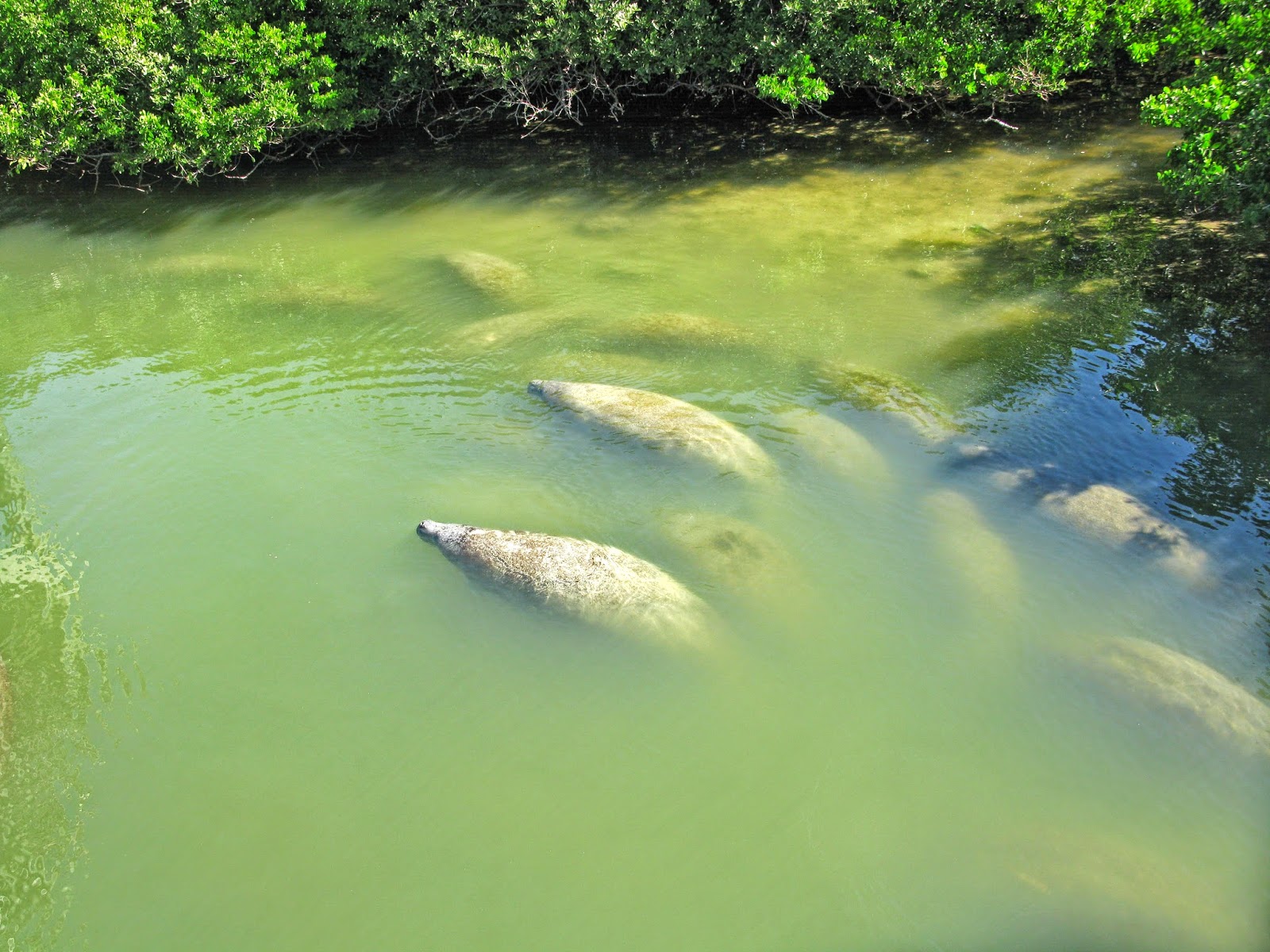
Like Elephants, Manatees are herbivorous. They eat sea grasses and other aquatic plants. Their teeth are molars only. I was told at the learning center that throughout their life new rear molar keep growing, pushing off and replacing the front molar. Amazing.
Florida Manatees like warm water; they can not stand water temperatures below 68 F for long extended time. During the winter, warm water discharge from Tampa Electric power plant provide refuge for the manatees in the water around the power plant. So the best time to view the manatees here, is during the cold winter months. We saw over one hundred manatees.
If you like nature and like to learn more about manatees, I highly recommend that you visit this place. It is about 45 minutes drive from Cearwater.
Here is a link to the Tampa Electric's Manatee Viewing Center. Admission is free.
On our way to Clearwater, we learned from the Florida Welcome Center on I-75, of locations to see these unusual animal. Apollo Beach (Tampa Bay) Manatee viewing center was the nearest to our place. It was a cool and beautiful sunny day.
There are several Manatee species. The Florida Manatees are native to Florida.
I found the Manatees to be unusual because they are mammals but live in water. They have lungs and breathe air just like other mammals. Genetically their close 'cousin' is the Elephants.
They can hold their breath, under water, up to 20 minutes before coming to the surface for air.
The Florida Manatee has a large tube shape body, a flat paddle shaped tail and two short flippers. Adult manatee average 10 feet long and weighs around 1200 lbs. They could live for 60 years or more. At birth calf (baby manatee) ranges from 3 to 4 feet long and weigh 60 to 75 lbs.
Like Elephants, Manatees are herbivorous. They eat sea grasses and other aquatic plants. Their teeth are molars only. I was told at the learning center that throughout their life new rear molar keep growing, pushing off and replacing the front molar. Amazing.
 |
| Theresia with a 'baby manatee'. |
Florida Manatees like warm water; they can not stand water temperatures below 68 F for long extended time. During the winter, warm water discharge from Tampa Electric power plant provide refuge for the manatees in the water around the power plant. So the best time to view the manatees here, is during the cold winter months. We saw over one hundred manatees.
 |
| Power plant |
If you like nature and like to learn more about manatees, I highly recommend that you visit this place. It is about 45 minutes drive from Cearwater.
Here is a link to the Tampa Electric's Manatee Viewing Center. Admission is free.
Sunday, 14 September 2014
Around lake Erie - day 11, last day.
Day 11, Wednesday August 27 2014.
From Brantford to Brampton - 103.3 km
Started early, about 7:00 AM. I wanted to cover as much distance as possible before the heat of the sun got to me. Managed to get out of the city without too many difficulties.
After coffee break, I put on more sun screen and extra protection, bandanna, over my head. The sun rays were hot. Cycling North West on King St. W. and Brock Rd. was tough, as it was a long, felt like 5 km long, winding, steep uphill. Stopped and rested once. It was definitely one of the toughest hill I cycled on.
Saw another llama farm. Raising llamas seemed popular in this area.
The 2 km stretch on Mississauga Rd. going North was likely the most challenging ride of the day. It was hilly and much worst, strong wind in my face. Moved slowly.........6 to 7 km per hour, snail pace.
From Brantford to Brampton - 103.3 km
 |
| Day-11 route |
Started early, about 7:00 AM. I wanted to cover as much distance as possible before the heat of the sun got to me. Managed to get out of the city without too many difficulties.
At 18.4 km, the cue sheet direction was to make a left turn to Kitchens Trail, but the trail was closed. Apparently for quite some time judging from the size of bushes and trees that had grown on the path. The gps software needed updating.
I decided to continue East until the next intersection then turn left, North, and back to the planned route.
The next intersection was hwy.#52, made a left and headed North. Unfortunately this was a very busy highway with many trucks traffic. So at the next intersection which was Governors Road, I turn right and headed East again. Close to 10 km later I was in the city of Dundas. Stopped for coffee at Tim Horton's and used their free WiFi to study the route on my Nexus7 tablet. The map showed that if I cycled through downtown Dundas King Street, going North West, it will connect to Brock Rd. which in turn, at the 50 km, joined the planned route. Great!
 |
| The road must had been closed for some tine............ |
 |
| Extra protected from the sun rays......it was a hot day. |
 |
| Another llama farm? |
The sky was clear and the sun rays hot; needed frequent breaks and cooling off in the shade.
Took a break near the 401 and Cambellville Rd intersection. Was planning to have a couple of oranges and a boiled egg for lunch, but could not find where I had stored them, must have left them at the hotel. Instead I just ate a couple power bars. My brain was a little fuzzy.
The wind picked up, it was mostly coming from the North. By this time I was cycling to the East, so it did not bother me much. It brought some clouds. I took off the bandanna that was covering my neck and ears from the sun.
Near Milton, road signs indicating that #5 side road was closed to traffic, reminded me of my day-1 on the tour. This was the same one. It was Wednesday around 3:00 PM, hoped the workers would let me through.
Did not see anybody working at the closure. The construction of the Bridge had some progress compared to 10 days ago. Carefully walked Shadow pass the barriers. Lucky.
Near Milton, road signs indicating that #5 side road was closed to traffic, reminded me of my day-1 on the tour. This was the same one. It was Wednesday around 3:00 PM, hoped the workers would let me through.
Did not see anybody working at the closure. The construction of the Bridge had some progress compared to 10 days ago. Carefully walked Shadow pass the barriers. Lucky.
 |
| Arrived home...........end of tour. |
 |
| Home with Theresia and Edward. |
Cycled mostly on the sidewalk along Williams Parkway; arrived home 4:33 PM. Theresia was anxiously waiting for me in the front yard. Edward cycled to meet me but we crossed paths.
 |
| With Hoey and Ed. |
Hoey came over to welcome me home. Had a cold beer and started thinking 'What is next????'
End.
End.
Subscribe to:
Posts (Atom)